



This website uses cookies
We use cookies and similar technologies to improve your experience, analyze site traffic, and personalize content. By clicking "Accept All", you agree to our use of cookies. You can manage your preferences at any time in .
Owner Resources
Your umbrella is built to work outdoors for years. A little upkeep through the season keeps the fabric true and the frame turning freely.
Most of what shortens an umbrella's life happens in the first few seconds of opening or closing it. Take those slowly and the rest looks after itself.
Never move or rotate the umbrella while it is open. Side load on an extended arm can bend a rib or unseat the frame from the base, and it is the most common cause of damage we see.
Set the tilt with the canopy open and the frame settled, then release the handle so it locks. On a cantilever model, close the canopy before you press the foot release and swing the umbrella to a new position.
A patio umbrella is a shade device, not a wind structure. No canopy, and no amount of ballast, makes an open umbrella safe in a gust front.
Damage from wind is not a defect in materials or workmanship, so it falls outside warranty coverage. Closing the umbrella is the whole defense.
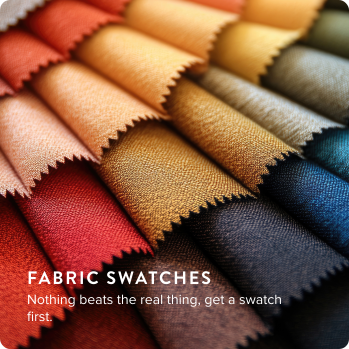
All of our fabrics are solution-dyed, which means the color runs through the fiber rather than sitting on the surface. They rinse clean and they hold their color, but they do want the gentle approach.
| Fabric | Composition | UPF | Fade Resistance | Warranty |
|---|---|---|---|---|
| Sunbrella® | Solution-dyed acrylic | 98+ | Excellent | 5 year |
| Pacifica | Solution-dyed polyester | 98+ | Great | 4 year |
| Solstice (prev. Olefin) | Solution-dyed | 90+ | Essential | 1 year |
Check your order confirmation or the product page for the fabric on your umbrella.
Brush loose dirt off the dry canopy, then hose it down every few weeks. Doing this often enough keeps you from ever needing a deep clean.
Mildew grows on what collects on the fabric rather than on the fabric itself, so it cleans off. For Sunbrella®, add one cup of bleach and a quarter cup of mild soap to a gallon of water, let it sit for fifteen minutes, then scrub lightly and rinse until the water runs clear. Test an out-of-sight corner first, and rinse any nearby planting.
Keep away from the canopy: pressure washers, solvents, abrasive cleaners, fabric softener, and any cleaner labeled for vinyl or automotive use. These strip the water-repellent finish and the damage does not reverse.
The factory finish sheds water for years, but it wears down with repeated deep cleaning. Once water soaks in rather than beading, re-treat the dry, clean canopy with a fabric guard made for outdoor acrylic, following the directions on the can.
Our frames are aluminum with a powder-coated or anodized finish, chosen so they hold up to sun and salt air without rusting. They need very little.
Do not use abrasive pads, scouring powder, or solvent on a finished frame. They will cut through the coating.
Ballast is what keeps the umbrella upright, and it is sized to the model rather than to the patio. Check the recommended base weight for your umbrella on its product page or in the instruction manual that came with it, and meet it before you open the canopy for the first time.
Meeting the recommended ballast is a condition of warranty coverage for anchor-related incidents. If you are not sure what your model calls for, ask us before the first windy day.
Umbrellas that get put away dry and clean come out of storage looking like they went in.
Empty and drain a water-filled base before the first freeze. Water expands as it freezes and will split the housing.
Most of what wears out can be replaced without replacing the umbrella: canopies, ribs, finial caps, bottom poles, base parts, and umbrella pins. Have your model number ready and we can match the part to your frame and finish.
Shop Replacements Read the FAQCoverage runs by fabric and by component, and the full terms, including what is covered and how to make a claim, are published with our terms of use.
View Warranty TermsWind damage, accidental damage, and normal wear are not covered. Keeping to the ballast, wind, and cleaning guidance on this page is what keeps coverage intact.
Monday to Friday, 8 am to 5 pm Pacific. Have your model number handy — it's on the canopy label, your manual cover, or your order confirmation.
Chat With Us Call +1 909 622 4800